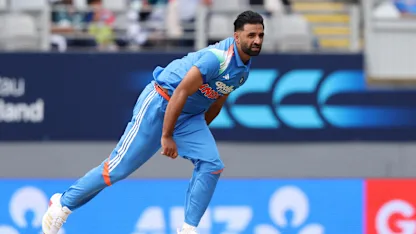
India's batting failures in New Zealand concern coach Gambhir
India head coach stressed the need to adapt to New Zealand conditions with the ICC Men's Cricket World Cup in sight.

India head coach Gautam Gambhir has called on his batters to sharpen their mental and technical adaptability ahead of next year's ICC Men's Cricket World Cup, following a heavy 244-run defeat to New Zealand in the fourth ODI in Mount Maunganui.
Chasing 334 at Bay Oval on Friday night, India were bowled out for 89 in 26.4 overs as Matt Henry claimed a six-wicket haul to keep the five-match series alive at 2-1 heading into Sunday's finale.
Gambhir did not shy away from India's recurring top and middle-order struggles in seam-friendly conditions, pointing out that the side had also slipped to seven wickets down while chasing 135 earlier in the series.
"There's no benefit to sweeping it under the carpet," Gambhir said in his post-match press conference on Friday night.
"It isn't just this match. Even in the previous match, we were seven down for 111.
"It is a bit of a concern, because yes, there is some help here for the bowlers, so we have to be not only mentally but from the skill point of view we need to be ready as well.
"In India, the easiest time for batting is the first 10-15 overs. Here it's probably the hardest time. This is the difference in these conditions, and with the amount of experience we have, hopefully we can adapt in the last game."
With the 2027 Men's Cricket World Cup in South Africa, Zimbabwe, and Namibia on the horizon, Gambhir noted that New Zealand's surfaces offer the closest replica to the pace and bounce conditions India will face next year—making Friday's rapid collapse particularly concerning.
"For me, I think the bigger concern [from Friday's game] is not the runs; it's how quickly we got bundled out - I think in around 26 or 27 overs [26.4 overs], so hopefully we can try and rectify that as soon as possible."
Dismissing suggestions that New Zealand's seamers extracted excessive lateral movement, Gambhir attributed the collapse to batters getting caught on the crease against disciplined lengths.
"Honestly, I don't go into this much technicality, wobble seam and all that," Gambhir said.
"We create all these things - wobble seam, scrambled seam, cross seam. Ultimately, it is the job of the batters to negate the movement. Whether it is the upright seam, wobble seam or scrambled seam.
"There are no unplayable deliveries in international cricket. Matt Henry bowled in good areas, but we should be able to negate that."
India's woes were compounded in the field early in New Zealand's innings when centurion Will Young (125) was dropped twice on five off the bowling of Auqib Nabi - reprieves that proved decisive as the hosts piled on 333.
"I thought Arsh [Arshdeep Singh] and Auqib bowled really well," Gambhir said.
"Auqib was a bit unlucky because had we got Will Young in that first couple of overs, probably things could have been a lot different.
"Once you are in, you want to try and make the most of it, and that is what Will Young did. He got those two chances, and he made the most of it, and someone who gets 120 when you are batting first, obviously, you have capitalised on the opportunities.
"Things could have been a lot different, but there is always hindsight to what you do because we dropped catches, no one else did, so we had to pay for it."
Gambhir also explained India's bowling balance, noting the role of middle-overs enforcer Gurnoor Brar and the tactical call to bring in a wristspinner on Bay Oval's larger dimensions.
"Obviously we have one guy who has that [shorter] natural length, Gurnoor," Gambhir said.
"He hits the deck hard, and that is what his job is, to come in the middle overs and try and use that short ball, and that is exactly what he was successful with in the first two games.
India will look to seal a 3-1 series triumph when the two sides meet again at Bay Oval for the fifth and final ODI on Sunday, 15 November.
India v New Zealand ODI series schedule:
First ODI: November 4, Auckland [India won by 5 wickets (DLS method)]
Second ODI: November 7, Wellington [India won by Four Runs (DLS Method)]
Third ODI: November 10, Hamilton [No result]
Fourth ODI: November 13, Mount Mounganui [New Zealand won by 244 runs]
Fifth ODI: November 15, Mount Mounganui